
Compare the best theory test apps for UK learners, see how official DVSA questions and four in one practice fit together, and follow Mudassar’s study plan...

Pass the Hazard Perception Test: DVSA Plan to Reach 44/75
Click as soon as a hazard starts to develop: that single habit raises your score most reliably. The hazard perception test uses 14 video clips containing 15 developing hazards, and you need 44 out of 75 to pass. You don’t need a perfect run, you need consistent, early reactions built through regular practice.
TL;DR:
- Click at the first sign of a developing hazard, such as indicator flickers or brake lights, rather than waiting for the hazard to become obvious.
- Practice reaction timing with official DVSA clips, aiming to respond early and avoid rhythmic or mechanical clicking patterns that are penalized.
- A score of 44 out of 75 is enough to pass, as most points come from early reactions; consistency is more important than perfection.
- Use slow-motion playback during practice to identify the precise moment a hazard begins, then repeat at full speed to improve response speed.
- Candidates with disabilities or health conditions can request adjustments like extra time or support, but must declare needs when booking and practice with those accommodations.
Table of Contents
- Top tips to use during the test
- How scoring works and what a pass looks like
- When exactly to click: techniques and timing
- How to practise effectively before test day
- Reasonable adjustments and accessibility options
- Common mistakes and quick fixes
- What I tell learners after every mock test
- Build hazard perception practice into your lessons
- FAQ
- Sources
Top tips to use during the test
A handful of habits account for most of the marks lost or gained, so it helps to run through them before you sit down at the screen.
- Click the moment a hazard begins to develop, not once it’s obvious.
- Use single, deliberate clicks rather than a steady tapping rhythm.
- Watch for the usual tells: a flashing indicator, a brake light, a pedestrian stepping towards the kerb, a driver’s head turning.
- Let go of a clip once it ends. Dwelling on a hazard you think you missed costs you marks on the next one.
- Base your practice around official DVSA material rather than random clips of unknown quality.
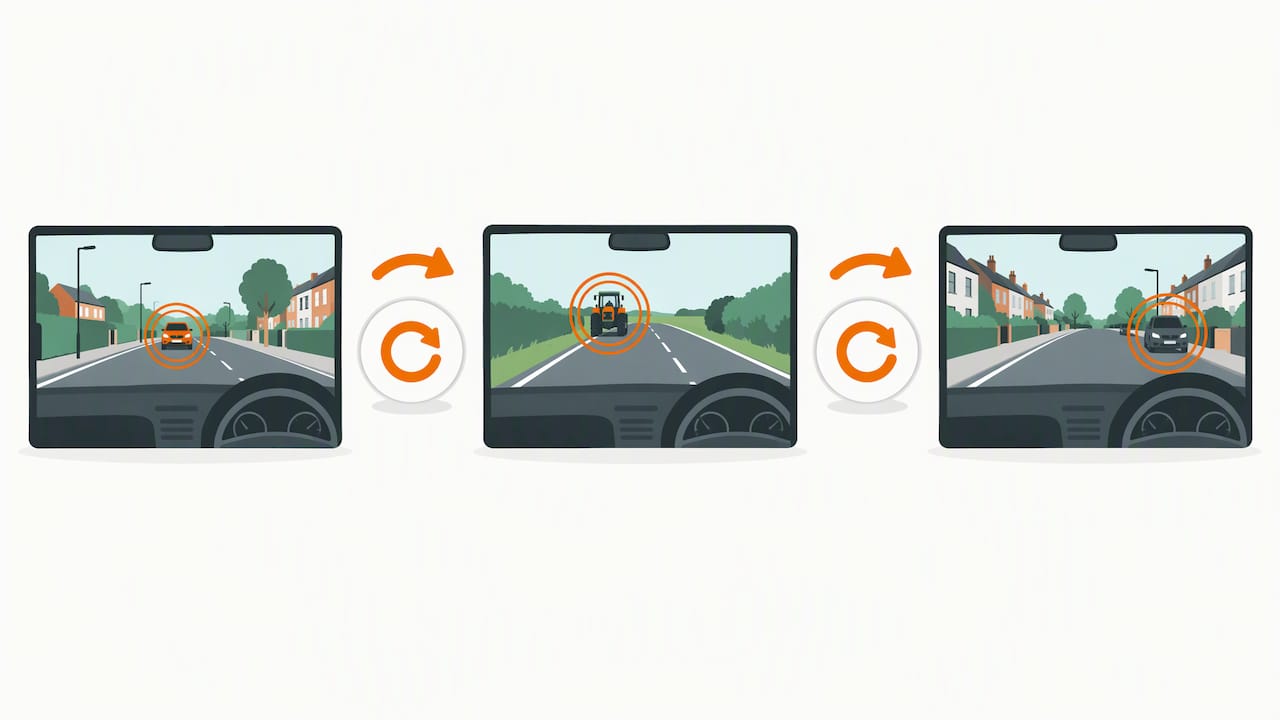
Most clips follow a familiar pattern once you’ve watched enough of them: a cause appears, the hazard develops, then the situation resolves. Training yourself to react at the cause, rather than the resolution, is what separates a comfortable pass from a near miss.
Pro Tip: Treat each clip as a fresh start. A missed hazard in clip 6 has no bearing on clip 7, so reset your focus the second the screen changes.
How scoring works and what a pass looks like
Each of the 14 clips contains at least one developing hazard, and one clip contains two, bringing the total to 15. For every hazard, you can score up to 5 points on a sliding scale: click early and you score close to the maximum, click late and you might only pick up a point or two.
- The pass mark for this section is 44 out of 75, so a handful of weaker clips won’t sink you if the rest are strong.
- Clicking in a steady rhythm instead of reacting to genuine hazards is flagged by the system and scores zero for that clip.
- Clicking after the hazard has clearly resolved earns little or nothing, because the sliding scale has already run down.
Needing 44 out of 75 means you can afford a few average responses, as long as most of your clicks land early. That’s a realistic target to practise towards rather than chasing a flawless score.
When exactly to click: techniques and timing
Timing is the whole game here, and it comes down to spotting the cause before the hazard becomes visually dramatic.
- Watch for the first physical sign: an indicator flicking on, a steering wheel turning, a cyclist glancing over their shoulder, brake lights coming on ahead.
- Click the instant that sign appears, not when the car pulls out or the pedestrian steps into the road.
- Be cautious with the so-called “3 click trick” of clicking several times in quick succession. The test is built to catch rhythmic clicking, and a clip can score zero if your pattern looks mechanical rather than responsive.
- If you do want a small buffer of clicks around a hazard, space them unevenly and base each one on something you actually notice changing, not a fixed count.
- Practise with slow-motion playback first, pinpointing the exact frame where a situation turns from “normal road scene” into “developing hazard”.
- Once you’ve identified that frame, repeat the same clip at full speed and try to click there consistently.
Pro Tip: Run the same clip three or four times across a session. Your reaction time to that specific hazard should get faster each time, which is exactly the skill the test is measuring.
How to practise effectively before test day
Good practice is less about hours spent and more about matching the real test conditions as closely as possible.
- Start with the official practice material linked from GOV.UK so you learn the format DVSA actually uses.
- Add a reputable app or practice package for extra volume once you understand the basics, avoiding free clip sets of dubious quality.
- Run short daily sessions of ten to fifteen minutes rather than one long cram, building the early-click reflex gradually.
- Once a week, sit a full mock test under timed conditions, no pausing, no replays, using a mouse rather than a touchscreen or trackpad.
- Drop any practice tool that encourages guessing or rewards rapid clicking regardless of timing, since it trains the wrong habit.
Clip sets that don’t score on DVSA’s sliding scale can leave you confident but unprepared, so check that whatever you use mirrors the real scoring before you rely on it.
Reasonable adjustments and accessibility options
If you have a reading difficulty, disability or health condition, you can request reasonable adjustments for your theory and hazard perception test.
- Extra time, British Sign Language support, read-aloud questions, or someone to record your answers are all available on request.
- Adjustments must be requested when you book, and some may need supporting evidence, so declare your needs early rather than on the day.
- Where possible, practise using the same adjustment you’ll have in the test, so the format feels familiar rather than new.
Further procedural detail on how these adjustments are applied is set out in DSA guidance for examiners.
Common mistakes and quick fixes
Most failed attempts come down to a small set of repeated habits rather than a lack of knowledge.
- Clicking late: train yourself to react to the cause of a hazard, not its outcome.
- Rhythmic clicking: swap pattern tapping for controlled, single clicks tied to something you’ve actually seen.
- Dwelling on a missed hazard: reset mentally as soon as a clip ends and treat the next one as independent.
- Practising on poor-quality clips: stick to DVSA material or a vetted app that mirrors the real scoring system.
What I tell learners after every mock test
I’m Mudassar, and in lessons I find hazard perception practice works best when it’s tied to what you’re already doing behind the wheel. The same cues we point out on the road: an indicator two cars ahead, a pedestrian edging off the kerb, carry straight across to the test screen. Learners who connect the two tend to click earlier and more naturally, because they’ve already trained the habit in traffic rather than just on a laptop.
— Mudassar
Build hazard perception practice into your lessons
Pairing screen practice with real road feedback is where most learners see the fastest improvement, and that’s where structured lessons make a difference. Our test preparation and mock test sessions let you practise spotting developing hazards in live traffic, with an instructor pointing out the exact cues the test rewards, rather than guessing from a screen alone.

- Intensive courses offer concentrated practice sessions before your test date.
- Refresher sessions are available for those who want to sharpen specific habits.
- Tuition options include both automatic and manual transmission to match your test vehicle.
Full details on lesson types and current pricing, including our First Driving Lesson from £37.50 per hour, are on our prices page. If you’d rather start with automatic or manual tuition specifically, our automatic driving lessons and manual driving lessons pages cover what each course involves. Book a session through Connect Driving School and bring your hazard perception practice into the car.
FAQ
What is the trick to passing a hazard perception test?
There’s no single trick, but the most reliable habit is clicking at the first sign a hazard is developing rather than waiting until it’s obvious. Combine that with steady, non-rhythmic clicks and regular practice on official DVSA material for the best results.
What is the 3 click trick for hazard perception?
Some learners use a short burst of clicks around a hazard instead of just one. This carries real risk, because the test penalises rhythmic or pattern clicking, and a detected pattern can score zero for that clip, so any extra clicks need to be uneven and genuinely responsive, not timed.
How do I practise for the hazard perception test in the UK?
Start with the official practice clips available through GOV.UK, then add a reputable app for extra volume once you understand the scoring. Short daily sessions combined with a weekly timed mock test, using a mouse and no pauses, best replicate real test conditions.
Is 62 out of 75 a good hazard perception score?
Yes, scoring comfortably above the pass mark of 44 out of 75 clears the test. You don’t need a near-perfect score to pass, just consistent early clicks across most of the 14 clips.
Can I get extra time or support for the hazard perception test?
Yes, candidates with a reading difficulty, disability or health condition can request reasonable adjustments, including extra time, BSL support, or someone to record answers. These need to be requested when booking, and practising with the same adjustment beforehand helps build confidence.
Sources
Related Posts

Comments (0)